

The Rainbow Registered designation is more than just a symbol; it’s a commitment to creating welcoming and inclusive spaces and demonstrating accountability to 2SLGBTQI+ communities.
What does it take to earn this recognition and uphold this standard of accountability?
The assessment criteria are robust, grounded in validated National Guidelines, and designed to identify the specific policies, practices, and behaviours expected of accredited businesses and organizations.
Why are the criteria important?
The assessment process is built around two fundamental principles:
- Clear and Relevant Standards: The criteria are measurable and attainable, reflecting both current best practices and anticipating emergent needs in 2SLGBTQI+ inclusion.
- ‘Market Ready’ Focus: The standards are specifically tailored to meet the needs and interests of 2SLGBTQI+ consumers, ensuring accredited businesses are truly ready to serve 2SLGBTQI+ communities.
The Four Pillars of 2SLGBTQI+ Inclusivity
Accreditation is assessed through a holistic review centred on four distinct but related pillars. Applicants must meet the program standard for each of these categories to achieve the designation.
| Policies and Practices | Training | Commitment to Inclusive Leadership | Culture of Inclusivity |
| The official rules and procedures that govern operations. | Ensuring all staff are equipped with the necessary knowledge and skills. | Demonstrating leadership’s dedication to driving inclusion and accountability. | The day-to-day behaviours and environment experienced by staff and customers. |
Providing Your Evidence
During the accreditation process, organizations are required to provide evidence to demonstrate they meet the program standard for each pillar. This evidence provides concrete proof of the organization’s adherence to the criteria.
Below, we have included a basic guide to each pillar, with examples of approved evidence pieces.
The examples provided are for guidance and illustrative purposes only. They are not meant to be copied verbatim and should not be repurposed without a thorough review by legal counsel. Organizational policies must be tailored to an individual company’s or organization’s specific needs, structure, and legal obligations under applicable federal, provincial, and territorial laws. The assessment process is nuanced; your evidence may need to be tweaked, enhanced, or otherwise adjusted based on the distinct size, structure, and offerings of your business.
The four pillars, when taken together, ensure a comprehensive approach to 2SLGBTQI+ inclusivity that establishes trust and demonstrates genuine accountability to 2SLGBTQI+ communities.
1. Policies and Practices
Program Standard:
The business/organization’s policies and practices are non-discriminatory and respectful of sexual orientation and gender identity.
Category Importance:
Organizational policies, whether formal or informal, articulate the values and priorities that direct its actions. They provide information and clarity to staff, volunteers and customers regarding organizational expectations. Practices are the expression of policies in action and of organizational culture. An organization that is 2SLGBTQI+ inclusive and affirmative will establish relevant and purposeful policies and practices.
Examples of Evidence/Indicators:
- Non-discrimination policies that ensure equal treatment of staff and volunteers.
- Equal administration of staff benefits.
- Policies and practices that show the organization follows sexual orientation and gender identity non-discrimination laws.
- Policies and practices that support transitioning employees.
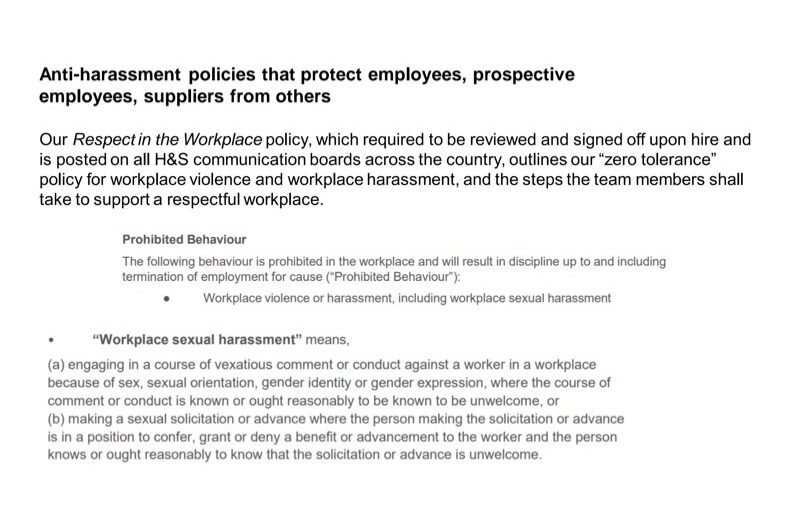
- Anti-harassment policies that protect customers from other customers.
- Anti-harassment policies that protect employees/volunteers from other employees/volunteers and customers.
- Mitigation policies and response practices for negative customer and staff/volunteer experiences.
- Requirement for gender neutral restrooms for staff, volunteers and customers.
- Policies and practices reflect use of gender-neutral / respectful language in organizational operations (e.g., respect for personal pronouns).
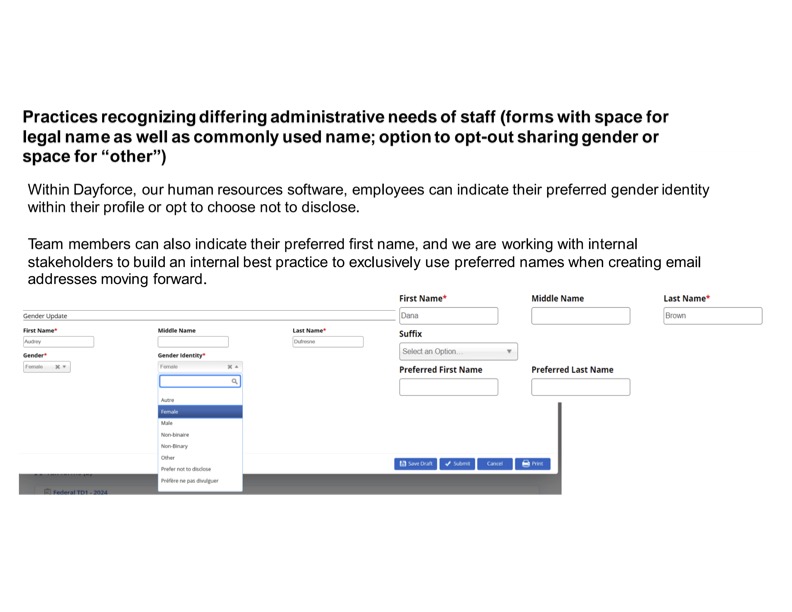
- Policies and practices recognize differing administrative needs of staff/volunteers/customers (e.g. accessible forms that provide space for a legal name as well as a commonly used name).
- Policies and practices set expectations for – and responses to – staff behaviour outside of work.
Questions to ask:
Does your workplace…
- pay staff equally regardless of gender or gender equality?
- explicitly state adherence to the Canadian Human Rights Act in an Employee Handbook?
- have any specific policies that accommodate transitioning employees? e.g. space on relevant documents for a legal name as well as preferred name, inclusive medical leave policies etc.
- have an Anti-Harassment policy that covers customer behaviour?
- have a policy to review and address staff or customer experiences dealing with gender identity or expression?
- show respect for pronouns? e.g. included on name tags, the option to include pronouns in e-signatures etc.
- employ gender neutrality across communication and policies? e.g. an “other” and an opt-out option of gender identification.
- have any policies regarding respectful and inclusive after hours staff behaviour?
The following excerpt is courtesy of the YWCA Hamilton. The full policy, titled “Workplace Violence and Harassment Prevention Policy and Program,” can be accessed on their official website: ywcahamilton.org. It is provided as an educational example to illustrate the components of a public-facing anti-harassment policy in Ontario.
Workplace Violence and Harassment Prevention Policy and Program
YWCA Hamilton. (2019, June 17). Workplace Violence and Harassment Prevention Policy and Program. Retrieved from https://www.ywcahamilton.org/workplace-violence-and-harassment-prevention-policy-and-program/
Policy Statement
The YWCA Hamilton is committed to providing a safe and healthy work environment in which all individuals are treated with respect and dignity. Workplace violence and harassment will not be tolerated from any person in the workplace. All members of the YWCA Hamilton community, employees, students, volunteers, clients, members, residents, visitors, guests, contractors, subcontractors and board members, have the right to work, live and use our facilities in an environment free from violence and harassment.
Definitions
Workplace Harassment:
As defined by the Occupational Health and Safety Act (OHSA), workplace harassment means engaging in a course of vexatious comment or conduct against a worker in a workplace that is known or ought reasonably to be known to be unwelcome.
Examples of workplace harassment include:
- Remarks, jokes, taunts, or insults about a person or a group of people identified by a Prohibited Ground (e.g., such things as race, colour, place of origin, ancestry, ethnic background, gender, gender identity, pregnancy, citizenship, creed, sex, and sexual orientation, age, record of offences, marital status, family status, or disability).
- Displaying racist, sexually suggestive or other offensive or derogatory pictures, cartoons, or material.
- Insulting gestures or practical jokes based on sexual, racial, or ethnic grounds that cause embarrassment or awkwardness.
- Knowingly making a false complaint.
- Leering (suggestive staring) that makes a person feel humiliated, intimidated, or uncomfortable.
- Unwelcome sexual advances; requests for sexual favours; an implied or expressed promise of a reward, benefit, or advancement in return for sexual favours, or reprisal if such favours are not given.
2. Training
Program Standard:
The business/organization provides diversity and inclusion training for staff and volunteers and contributes to public education on diversity and inclusion.
Category Importance:
Staff and other representatives of the organization require training before they can enact organizational policies. Providing or supporting ongoing staff and volunteer training on the importance of 2SLGBTQI+ inclusion is key. Training on how to operationalize inclusion in their respective roles is also critical. Training may be provided through in-house efforts, post-secondary education, community programming, or from other training providers.
Examples of Evidence/Indicators:
- Diversity, inclusion and sensitivity training that includes 2SLGBTQI+ specific training.
- 2SLGBTQI+ specific diversity training (e.g. trans-specific education).
- Communications training, including use of gender-neutral language and respect for personal pronouns.
- Educating customers and the public about respectful and welcoming diversity and inclusion practices and behaviours, (e.g. fostering allyship).
- Education about implicit bias and challenging gender-based assumptions.
- Training on recognizing and addressing gender-based violence and harassment.
- Positive changes in knowledge, attitudes and behaviours of staff, volunteers and customers.
Questions to ask:
Does your workplace…
- provide specific training programs or materials to staff, contractors and volunteers on 2SLGBTQI+ inclusion? Is this mandatory for all new hires?
- commit to diversity and inclusion training an ongoing commitment, or is it a one-time session?
- provide a plan for how new knowledge is shared with the team?
- have a plan to ensure that staff who take in-depth training share their learnings with the wider team?
- provide training on recognizing and addressing gender-based violence and harassment?
- educate its customers and the public about its commitment to diversity and inclusion?
Training Resources
The following list of training resources is provided for guidance. The CQCC has not conducted a formal, third-party review of all organizations and their offerings listed below. However, based on our knowledge and engagement with 2SLGBTQI+ communities and business sectors, these are considered reputable and are a good place to begin your search for training.
- CQCC’s Rainbow Ready Program: https://airtable.com/app9t9XDiaiZP0HG9/pagjpG1XTEJuQTWH8/form
- CQCC Events: https://queerchamber.ca/events/
- Gender-Based Analysis Plus (GBA+): https://women-gender-equality.canada.ca/en/gender-based-analysis-plus.html
- Canadian Center for Diversity and Inclusion: https://ccdi.ca/
- Simply Good Form: https://simplygoodform.com
- Pride at Work Canada: https://prideatwork.ca/elearning/
- Feminuity: https://www.feminuity.org/
- MyWorkplaceHealth: https://www.youtube.com/@MyWorkplaceHealth
- The Canadian Centre for Gender and Sexual Diversity (CCGSD): https://ccgsd-ccdgs.org/
- Egale Canada: https://egale.ca/workplace-inclusion/
- Rainbow Health Ontario (RHO): https://www.rainbowhealthontario.ca/education/training/
- The 519: https://www.the519.org/education-training/
- LGBT YouthLine: https://www.youthline.ca/
- QMUNITY: https://qmunity.ca/education-training/training/
- Kind Space (Ottawa): https://kindspace.org/
3. Commitment to Inclusive Leadership


Program Standard:
The business/organization demonstrates leadership and commitment to 2SLGBTQI+ inclusion beyond its day-to-day operations.
Category Importance:
Through its ongoing commitment to advancing or promoting 2SLGBTQI+ inclusion, the organization demonstrates leadership. Actions that demonstrate organizational commitment to 2SLGBTQI+ inclusion beyond day-to-day operations are another way for businesses/organizations to express their values and priorities. An explicit organizational commitment to 2SLGBTQI+ inclusion may take the form of investment in continuous improvement, engagement in the local communities, in the choice of partners and suppliers, or through another mode.
Examples of Evidence/Indicators:
- Renewable declaration of commitment to 2SLGBTQI+ inclusion programming.
- Continuous improvement commitments.
- Demonstrated community support.
- Demonstrated community engagement.
- Philanthropic initiatives (CSR).
- Selection or rejection of suppliers based on their values and priorities.
- Selection or rejection of partners (e.g., social media influencers) based on their values and priorities.
Questions to ask:
Does your workplace…
- have a formal, renewable declaration of commitment to 2SLGBTQI+ inclusion?
- demonstrate support and engagement with 2SLGBTQI+ communities? e.g. financial contributions, sponsorships, or event participation
- use the business’s platform or influence to advocate for or promote 2SLGBTQI+ inclusion in the broader communities?
- consider values and commitment to diversity when selecting suppliers or business partners?
- assure that the venues used, (e.g. shared workspaces, restaurants frequented for staff outings, event spaces etc), have 2SLGBTQI+ policies and practices?
- stop working with a partner in the event that they display anti-2SLGBTQI+ sentiments?
- support internal committees or groups, like a Diversity, Equity, and Inclusion (DEI) committee, that are tasked with advancing 2SLGBTQI+ inclusion?
The following excerpt is courtesy of the Canadian Tire Corporation (CTC) The full declaration, titled “Future-proofing Belonging; 2024 Diversity, Inclusion & Belonging Year-in-Review,” can be accessed on their official corporate website: corp.canadiantire.ca. It is provided as an educational example to illustrate the components of a public-facing commitment to inclusive leadership, in Canada.
Canadian Tire Corporation (CTC)’s commitment is articulated in its public-facing “Diversity, Inclusion & Belonging (DIB) Year in Review” and on its corporate careers website. This commitment is embedded in its business strategy and goes beyond simple statements.
Examples of CTC’s actions that serve as a declaration of commitment:
- Public and Measurable Goals
- Active Community Engagement
- Employee-Led Initiatives
- Strategic Philanthropic Efforts
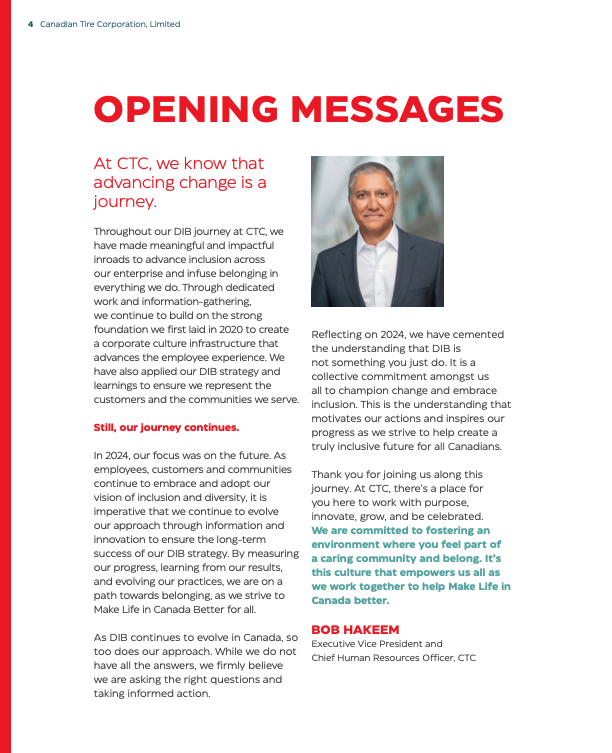
This demonstrates that CTC’s leadership is committed to ongoing, measurable progress in its DIB strategy, proving that their commitment is not a one-off action but a fundamental part of their corporate identity.
Some organizations work a declaration of commitment into their yearly strategic priorities:
Declaration of commitment by [Organization Name]
We, the team at [Organization Name], do hereby declare our commitment to inclusive leadership and 2SLGBTQI+ inclusion by committing to the following actions:
- Supporting and promoting 2SLGBTQI+ inclusivity within our business/organization.
- Engaging with local 2SLGBTQI+ communities.
- Providing 2SLGBTQI+ inclusivity training to new and existing staff/employees.
- Recognizing and celebrating 2SLGBTQI+ histories and events.
- Reviewing our policies and practices every year for 2SLGBTQI+ inclusion.
- Implementing inclusive communication practices, such as using pronouns in internal and external communications (e.g., email signatures).
- [Add any other specific commitments here].
On [Date of Signing], [Name of Leader/Signatory], in their role as [Title of Leader/Signatory], signed this declaration to demonstrate the organization’s commitment to advancing 2SLGBTQI+ inclusion.
This declaration of commitment will be formally renewed every year on the anniversary of the signing date.
4. Culture of Inclusivity
Program Standard:
The business/organization has established an organizational culture that is 2SLGBTQI+-inclusive and affirmative.
Category Importance:
A culture of inclusivity demonstrates authentic organizational values and priorities. Organizational culture starts at the top and flows throughout an organization. Culture is reflected through an organization’s internally- and externally-focused policies, programs and behaviours. Internal culture is reflected, for instance, in human resource policies, senior staff directives and employee-employee conversations. External culture is reflected in marketing materials, supplier/ partner arrangements, and employee-customer interactions, etc. An organization that is 2SLGBTQI+- inclusive and affirmative will consciously embody and express its values.
Examples of Evidence/Indicators:
- A code of ethics that reflects 2SLGBTQI+ inclusivity.
- Commitment to 2SLGBTQI+ inclusive practices in mission, vision and/or values.
- Diversity statement, policies or equivalents that explicitly include 2SLGBTQI+ considerations, (may include policies referenced in the first pillar.)
- Commitment to providing accountable environments, practices and behaviours for staff, volunteers and customers, (e.g. accessible and adequate reporting procedures for gender-based violence and/or harassment).
- Satisfactory responses to negative customer experiences and to negative staff/volunteer experiences.
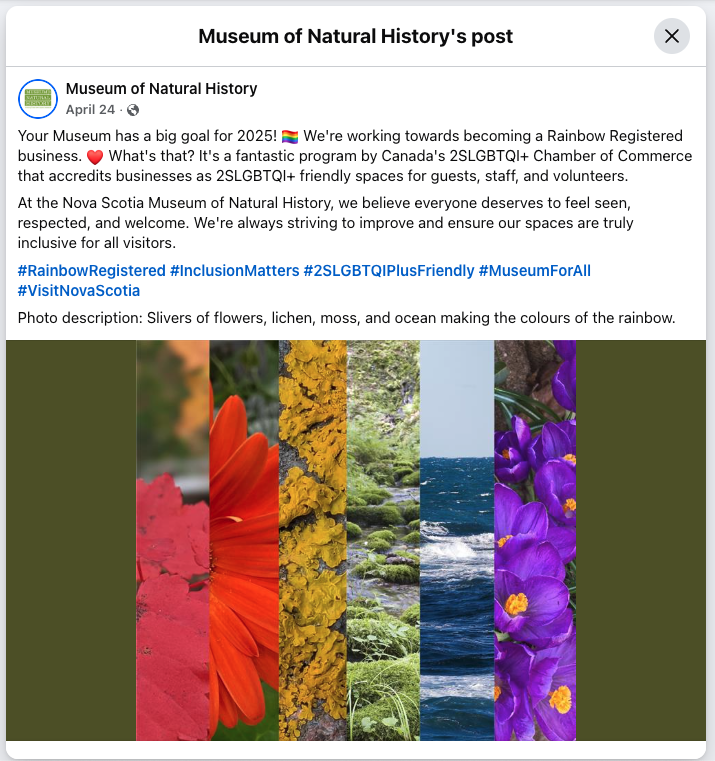
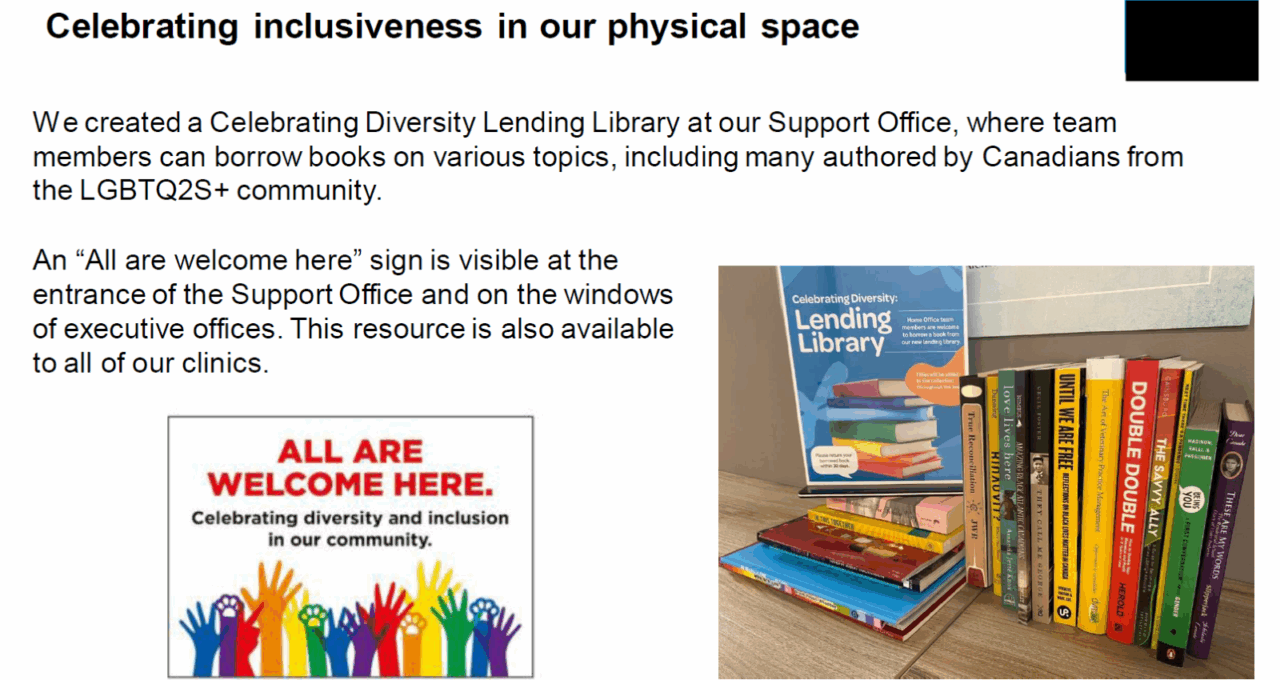
- Welcoming physical and virtual environments, (e.g. information, structures, resources).
- Marketing materials that feature language and/or imagery reflecting 2SLGBTQI+ communities.
- Use of gender-neutral and respectful language across operations.
- Positive staff, volunteer and customer views of organizational culture.
- Meaningful engagement with 2SLGBTQI+ communities.
- Commitment to fostering allyship.
Questions to ask:
Does your workplace…
- explicitly mention a commitment to 2SLGBTQI+ inclusivity in a mission, vision or value statements?
- physical or virtual environment signal a welcoming space for 2SLGBTQI+ communities? (e.g. displays of Pride or Progress flags in office or on websites).
- have gender neutral washrooms?
- include 2SLGBTQI+ reflective content in newsletters, on website, in social media posts or other marketing materials?
- measure or gauge the positive views of your organizational culture among staff, volunteers, and customers regarding inclusivity? (e.g. a feedback survey or positive reviews).
- have a concrete example of the appropriate steps taken to satisfactorily resolve a complaint or report of a negative visitor or employee experience?
The following example is courtesy of the Royal Bank of Canada. The full document, titled “Code of Conduct Integrity: Doing What’s Right”, can be accessed on their official website: rbc.com. It is provided as an educational example to illustrate the components of a public-facing code of conduct, in Canada.
Royal Bank of Canada, “Code of Conduct Integrity: Doing What’s Right”
The RBC Code of Conduct is a comprehensive document that outlines the company’s commitment to integrity, ethical behaviour, and legal compliance. It is publicly available on the company’s website. The code provides a framework for how employees should conduct themselves in various business relationships, including with clients, colleagues, and the broader communities.
The document is structured around several guiding principles:
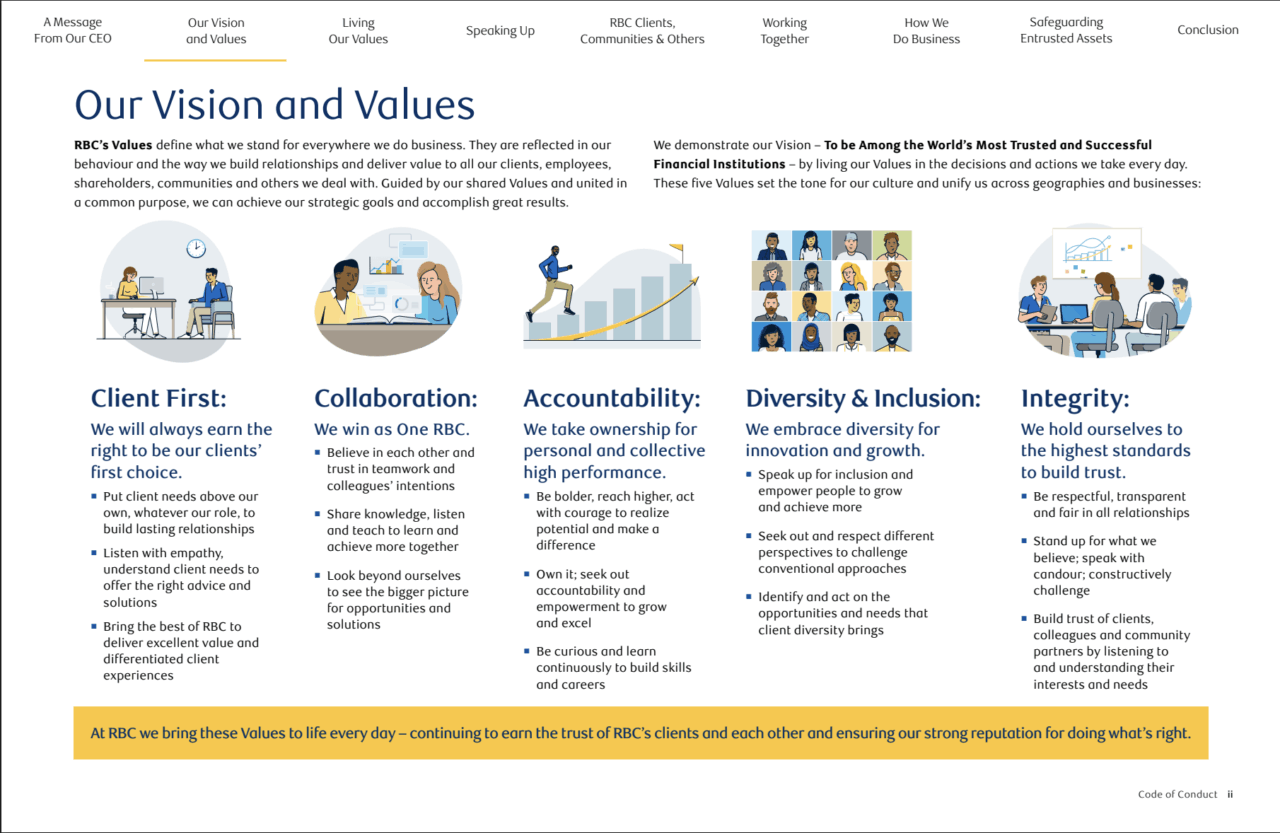
RBC’s code also includes detailed sections on topics like conflicts of interest, protecting client information, and maintaining a respectful workplace, and it is a good example of a public-facing document that can be used as a reference.
Please contact the Rainbow Registered team for guidance or with any questions relating to the program, an application or the four criteria pillars.
rainbowregistered@queerchamber.ca